AI Automation & AI Agents

AI Automation & AI Agents
AI Automation in Switzerland - redesign the work before automating it
inPositiv helps organisations identify where AI and automation can remove manual work, improve speed and reduce operational complexity.
We start with the process - then determine whether the right answer is automation, AI, an agent, system integration or a combination.
The opportunity
Where is work consuming more effort than it should?
Look for processes where people repeatedly:

Read, classify or extract information from documents

Search for information before making routine decisions

Prepare the same reports, emails or documents

Coordinate work manually across several tools

Handle high volumes of similar requests

Repeat predictable administrative steps
Our approach
Simplify first. Automate second.



1. Find the friction  We examine where time, cost, delays and errors occur in the current workflow.
This includes:
- Manual steps
- Repetitive decisions
- Handoffs between teams
- Duplicate data entry
- System gaps
- Approval bottlenecks
- High-volume knowledge work

2. Redesign the workflow Before introducing AI, we ask what can be removed, simplified or standardised.
The objective is not to automate every step.
It is to create a better process.

3. Choose the right type of automation Different problems require different solutions.
Depending on the workflow, this may include:
- Workflow automation For predictable, rule-based processes.
- System integration When information needs to move reliably between existing applications.
- AI assistants For work where people need help searching, analysing, drafting or summarising information.
- Knowledge and RAG solutions For controlled access to internal information and documents.
- AI agents For workflows where AI needs to perform a sequence of actions across tools and systems.
- Human-led AI Where AI supports the work but a person remains responsible for decisions or approval.
AI agents
An AI agent needs a job, not just a prompt
An agent becomes useful when its role in the business process is clearly defined.
Before implementing one, we determine:
-

What should trigger the agent?
-
What information can it access?
-
Which actions can it perform?
-
Which systems does it need?
-
Where does human approval remain necessary?
-
What happens when something goes wrong?
-
How will performance be measured?
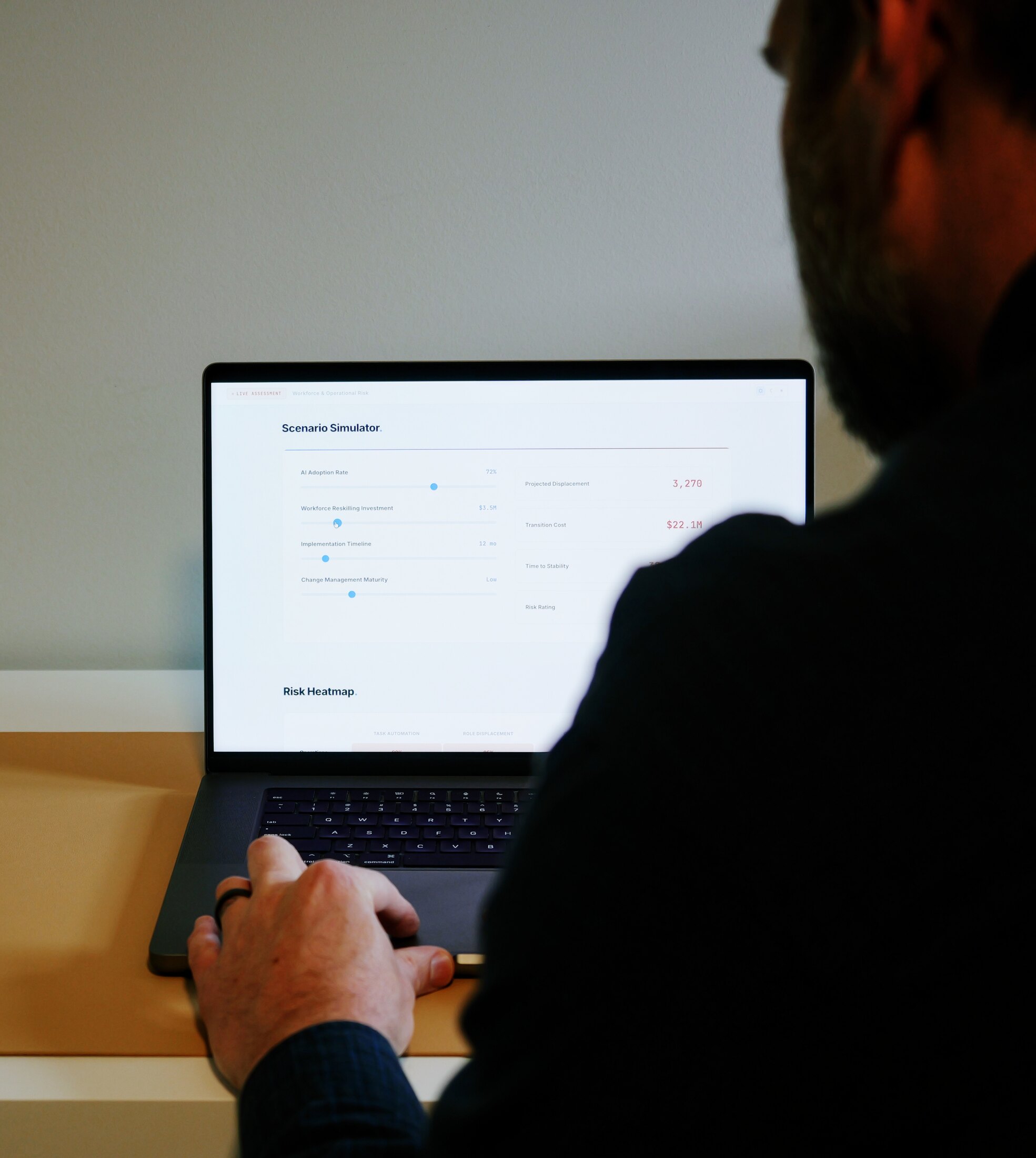
The goal is controlled operational value - not autonomy for its own sake.
Business case & control
Automate where the economics make sense
A technically possible automation is not automatically a good investment.

Volume
How often does the process happen?

Effort
How much human time does it consume?

Value
What improves if the process changes?

Reliability
How predictable is the work?

Risk
What happens if the system makes a mistake?

Integration
Which data and systems are required?

Control
Where must people remain responsible?
What you get
A practical automation plan
Depending on the engagement, this may include:


Opportunity map
Processes with meaningful automation potential.

Prioritised use cases
Opportunities ranked by value, feasibility and risk.

Target workflows
A clear view of how the redesigned process should work.

Automation approach
The appropriate combination of workflows, integrations, AI assistants or agents.

Control model
Human oversight, permissions, exceptions and escalation.

Business case
Expected impact and the measures required to evaluate it.

Implementation plan
Technical requirements, dependencies and next steps.
A focused starting point
AI Workflow Opportunity Review
For organisations that see automation potential but are not yet sure where to start.
The result is a prioritised view of the automation opportunities worth pursuing.
We examine selected workflows and identify:
- Where time and effort are being lost?
- What can be simplified?
- What can realistically be automated?
- Where AI adds value?
- Whether an AI agent is actually needed?
- What systems and data are involved?
- Which opportunity should come first?
Swiss context
Automation with control built in
AI automation can involve sensitive company data, external AI services and access to business-critical systems.
We consider data protection, security, permissions, data location, human oversight and operational control as part of the solution design.

FAQ
Frequently asked questions about AI automation
What is AI automation?
AI automation combines automated workflows with AI capabilities such as understanding documents, generating content, retrieving knowledge or making context-dependent recommendations and decisions.
What is the difference between workflow automation and an AI agent?
Workflow automation follows a predefined sequence of rules and actions. An AI agent can interpret information, choose between actions and perform multiple steps toward a defined objective. The appropriate approach depends on the process, risk and required level of autonomy.
Which business processes are suitable for AI automation?
Good candidates often involve repetitive work, high volumes, manual information processing, predictable decisions or frequent movement of information between people and systems.
Does every automation need AI?
No. Many processes are better solved through simplification, standard automation or system integration. We use AI only where it adds meaningful value.
Can AI automation work with our existing systems?
Often, yes. The implementation depends on available APIs, integrations, permissions, data and the technical architecture of the existing systems.
Can inPositiv implement AI agents?
Yes. inPositiv defines the business process, use case, controls and implementation requirements. Where custom engineering and integration are required, the technical solution can be delivered with cogify.
What work should your people no longer be doing manually?
We help identify what to simplify, what to automate and where AI can genuinely improve the process.